


In this newsletter
This week’s developments
Source: AEC field notes
🛫 Fasten your seatbelts: AI joins air traffic control
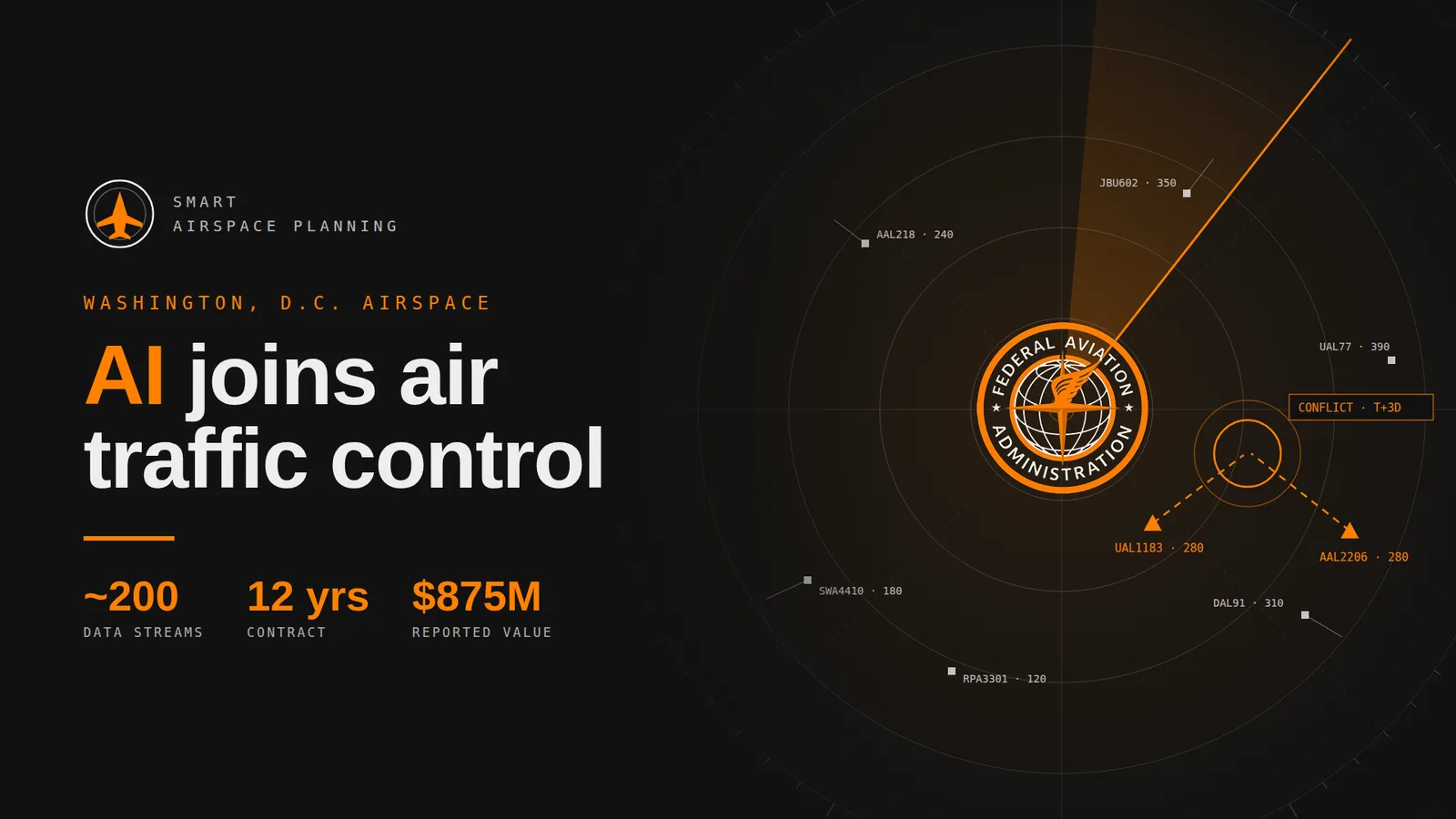
In summary: The FAA just switched on SMART in Washington, D.C. airspace, an AI planning layer from Air Space Intelligence that spots traffic conflicts before flights leave the gate - backed by a 12-year contract the WSJ puts at $875M.
The details:
SMART (Strategic Management of Airspace, Routes and Trajectories) pulls around 200 data streams, from airline schedules and weather to runway capacity and controller staffing, into one live picture of the airspace
The FAA says it can flag demand, weather and airspace crunches days or weeks ahead, and it keeps revising those forecasts as conditions change through the day
FAA staff vet every recommendation and local facilities can turn it down, while controllers keep aircraft separated and SMART never takes control of a flight
Why it matters: Construction has the same split; programmes, procurement trackers, BIM/CDEs and logistics tools that never talk. Each run by different teams. A SMART-style layer that ingests all of them could support Contractors by flagging delays or programme clashes days or weeks out and offer options, with the Programme Manager still making the call.
Source: The Guardian
🏛️ AI's top CEOs take their case to UN Security Council
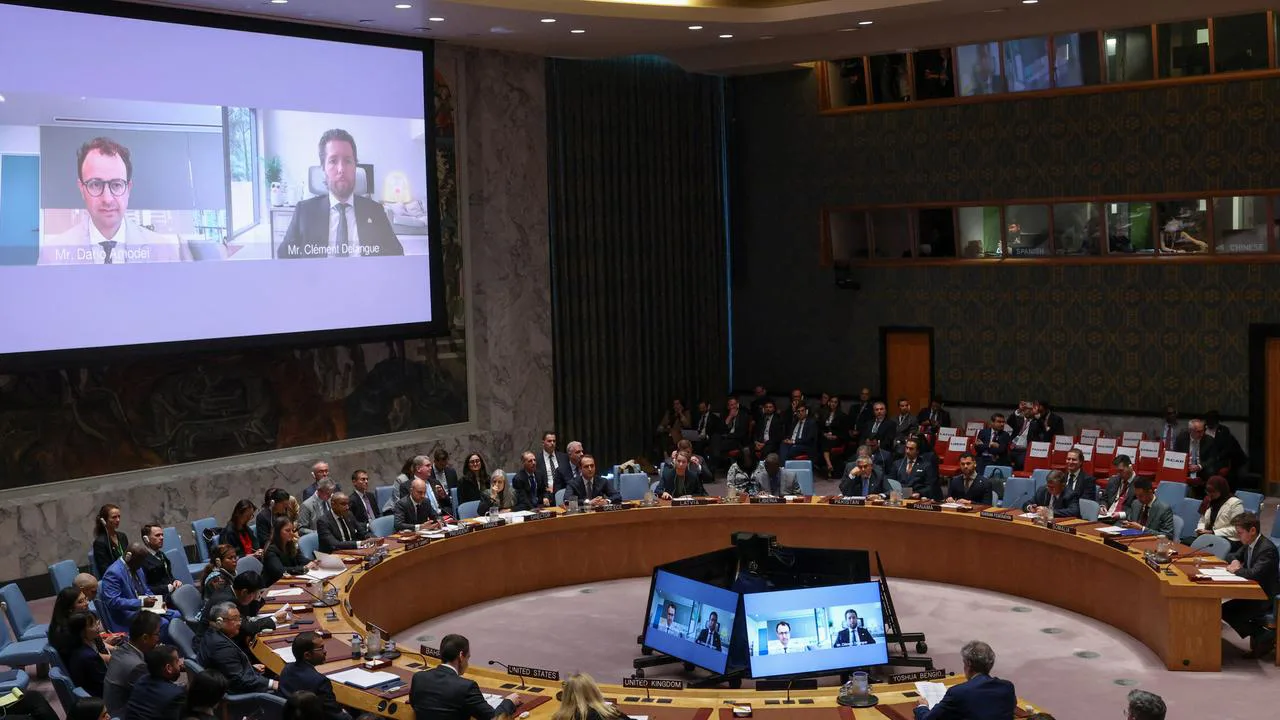
In summary: The UN Security Council just heard from the CEOs of OpenAI, Anthropic and Hugging Face, plus Yoshua Bengio, on AI and international security - a briefing that aired three competing visions for how AI should be governed (full transcript here)
The details:
The White House's rejected any "globalist scheme of control", while many others called for a single set of global principles and standards
Dario Amodei called for global standards and outside evaluators embedded inside labs with employee-level access, comparing them to food inspectors
Sam Altman pushed common national and international testing standards so countries can compare evidence, verify compliance and report incidents
Hugging Face's Clément Delangue warned about power concentrating in a few labs and argued for open models and mandatory disclosure of AI agent cyberattacks
Bengio, co-chair of the UN's 40-member AI science panel, said frontier AI should be licensed like other critical tech, with liability insurance required
Why it matters: The UN is building the scaffolding for shared standards. Sustainability rules built a workforce of ESG auditors, consultants, and carbon assessors, and AI standards could do the same. Expect thousands of jobs emerging from the sector-specific machinery needed to interpret, measure, test, audit and assure compliance. Once international standards crystallise, national implementation will move much faster.
AEC's likely new hire: Using the same sustainability analogy; ESG auditor / AI assurance auditor, Sustainability reporting manager / AI disclosure manager, BREEAM / LEED assessor / AI design certifier, Sustainability consultant / AI governance consultant, Chief Sustainability Officer / Chief AI Officer, etc.
Source: Cosmic Robotics
🏗️ Solar robot learns data centre pipe installs in 10 days
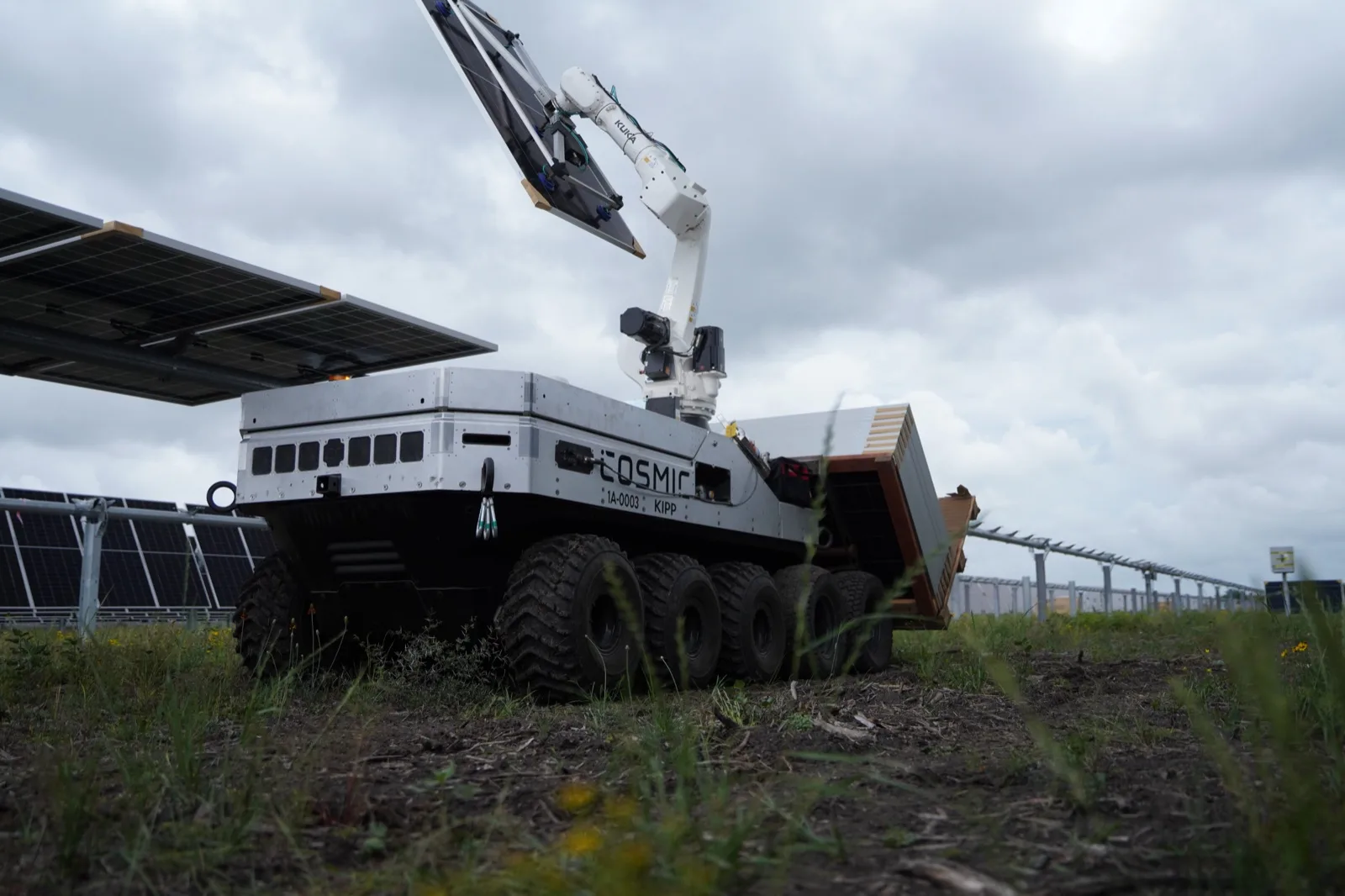
In summary: Cosmic Robotics, backed by Y Combinator, is pitching its solar panel installing robot, Cosmic-1, as a general-purpose platform after teaching it to fit large data centre cooling pipes in just 10 days, with no hardware redesign.
The details:
Cosmic Robotics robot Cosmic-1 has placed tens of thousands of solar panels on US utility-scale solar farms, where Cosmic claims 2x the labour productivity of manual crews
For the pipe job, the team swapped the arm's end effector and retrained the AI to detect, pick and install pipes that normally take several workers to move
CTO Lewis Jones says the pipe model was retrained overnight on synthetic data alone and deployed one-shot, crediting 18 months of tuning on live jobsites
Cosmic has won a NASA contract to develop edge-reasoning vision-language models for in-space and lunar applications
Why it matters: Solar is a first test: the same heavy lift repeated thousands of times, outdoors, in conditions that are harsh for crews and factory robots alike. It's also a testbed for Cosmic's reasoning and coordination software. Data centres are much harder, but repetitive enough to imagine Cosmic automating them one trade at a time.
AEC's likely new hire: Autonomous Machine Supervisor
Source: AEC field notes
🧩 Hugging Face hits 3 million open-weight models
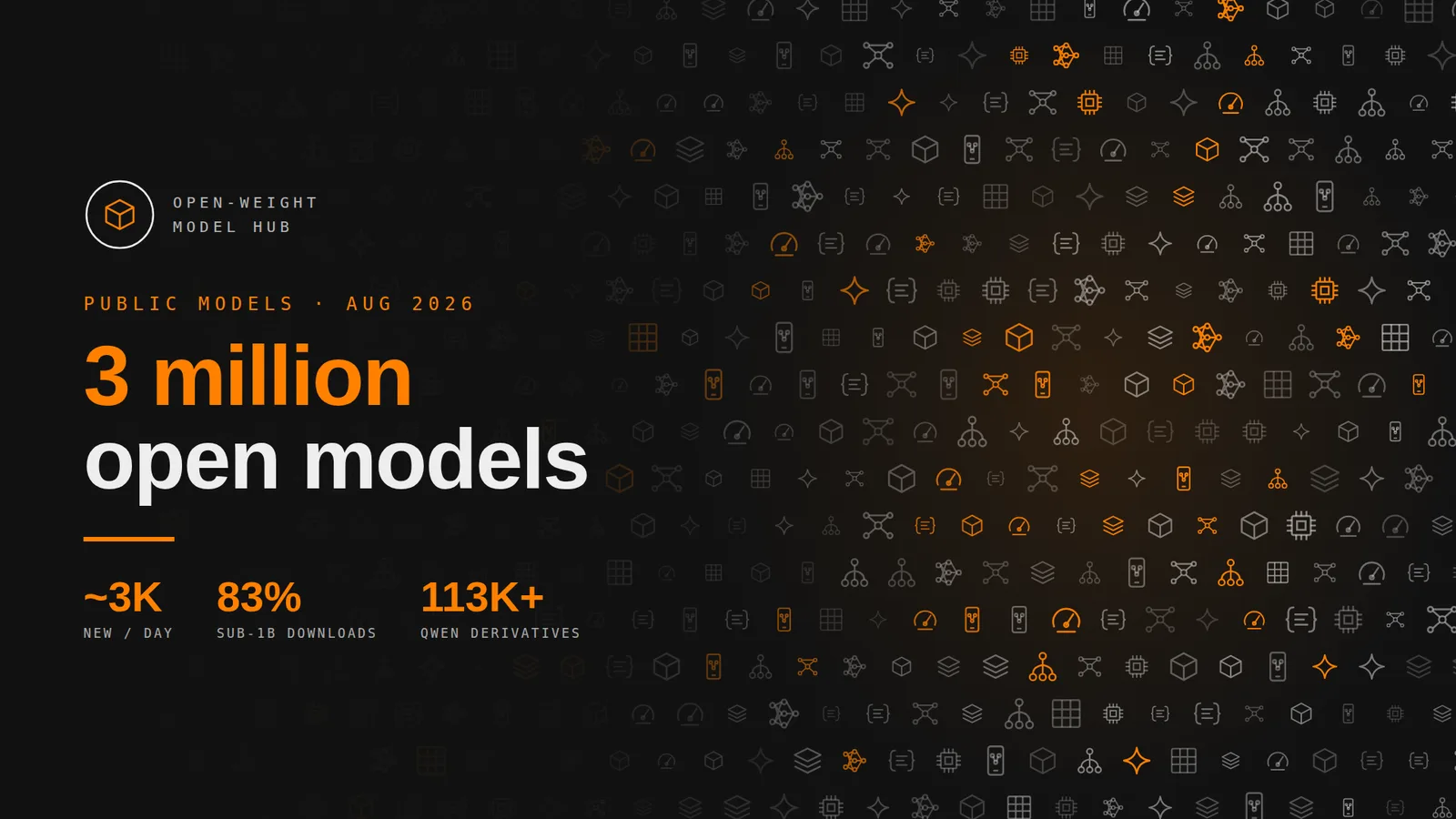
In summary: Hugging Face just crossed 3 million public models in August, with 2,700 to 3,000 more landing every day - most of them small variants of existing open models, with sub-1B models (which can run on your phone) taking 83% of downloads among those listing a size.
The details:
Hugging Face is a website where people share AI models. Anyone can upload a model, and anyone can download it and use it for free, usually on their own computer or servers. It's also where most "open" AI lives
Most model uploads are adapted versions of open-weight models, fine-tuned or quantised, and the Qwen family alone counts 113,000+ derivatives. New models are expensive to create
Generalist models are often adapted using data to do specialist tasks. Adapting an existing model is far cheaper than building one from scratch, which can cost millions
Why it matters: Open models run on a firm's own servers, so confidential client data never has to reach a remote API. Fine-tuning may be out of reach for most AEC firms, but keeping project data clean and machine-readable isn't. Clean data can already speed up a team today through retrieval (RAG), and could guarantee a firm's moat tomorrow.
AEC's likely new hire: Data managers
Source: AEC field notes
🔒 Safer ways to share data with AI
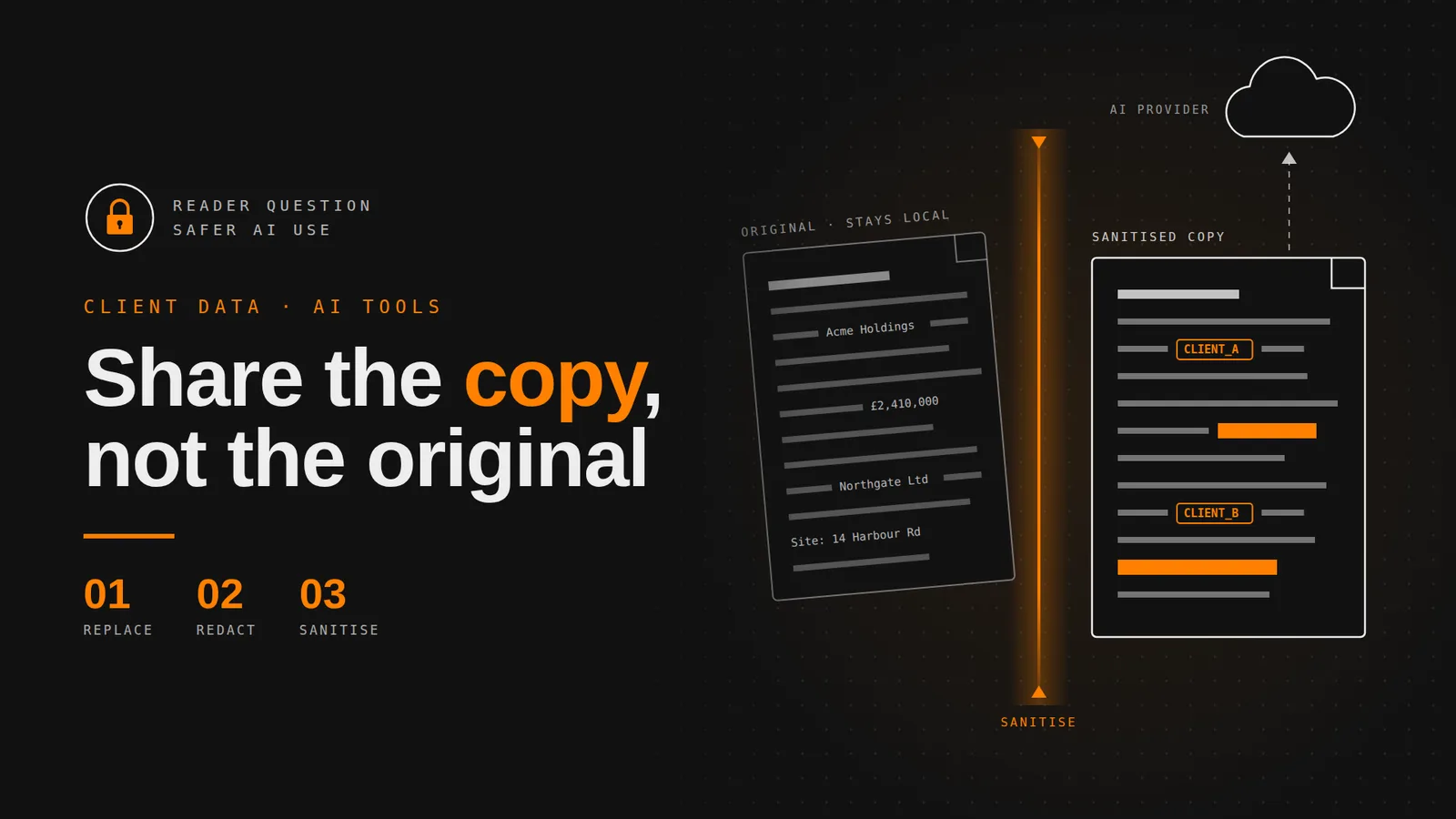
In summary: This week we are answering a readers request, who submitted their question using this form. Our reader asked how to use ChatGPT, Claude or Copilot without casually exposing client or company IP. The practical answer we can all apply today is to upload a sanitised copy of our files, not the originals.
The details:
On a ChatGPT, Claude, Gemini or Copilot accounts, every document you upload is still sent to the provider's servers to be processed
Switching off training stops your file feeding the next model, but the data doesn't stay local: the full original still leaves your machine
Today, the responsibility largely sits with the employee: you have to know what is sensitive, you have to remember not to upload it, and you have to redact it correctly
Practical steps to share data more safely:
Using Creative Cloud/Acrobat Pro,
For editable documents (Word, Excel, PowerPoint, etc): find-and-replace sensitive terms, then export to PDF and run Acrobat Pro's Sanitize Document (Tools, Redact a PDF, Sanitize Document)
For PDF documents: find-and-replace sensitive terms (Ctrl or Cmd + F), or redact them (Tools, Redact a PDF), then Sanitize Document
For Images: open image with Acrobat Pro and do an OCR pass first (Tools, Scan & OCR). Then follow the same steps as a PDF document.
If you do not have access to Creative Cloud/Acrobat Pro: I highly recommend ‘I Love PDF’, a website I have been using for years. Its paid desktop software offers similar tools for less. Both iLovePDF desktop and Acrobat Pro tools work offline, giving us the reassurance they aren’t sending our information externally in the precess.
Top tip: Swap names consistently (Acme becomes CLIENT_A) so the model still reads who owes what.
Trending AI Tools this week
Claude Opus 5.5 (Anthropic): Anthropic says it matches Fable 5.1 on most work and runs 40% cheaper than Opus 5
GPT-6 Sol and Luna (OpenAI): Cheaper GPT-6 tiers with API prices halved
Grok 4.7 (SpaceXAI): New larger base model for coding and knowledge work
MiMo-V2.6-Pro and Flash (Xiaomi): Open-weight omnimodal models; Xiaomi says Pro is the top-scoring open model on Artificial Analysis
Qwen-Image-2.1 (Alibaba): 7B open-weight model that generates and edits images, with native transparent-background output
Gemini 3.8 Live with Live Avatar (Google): Real-time video avatar for enterprise voice agents, with lip-sync across 97 languages, in Gemini Enterprise
That’s it for today!
See you next week with more exciting updates,
Eduardo - The human behind AEC field notes
London, UK