

In this newsletter
This week’s developments
Source: AEC field notes
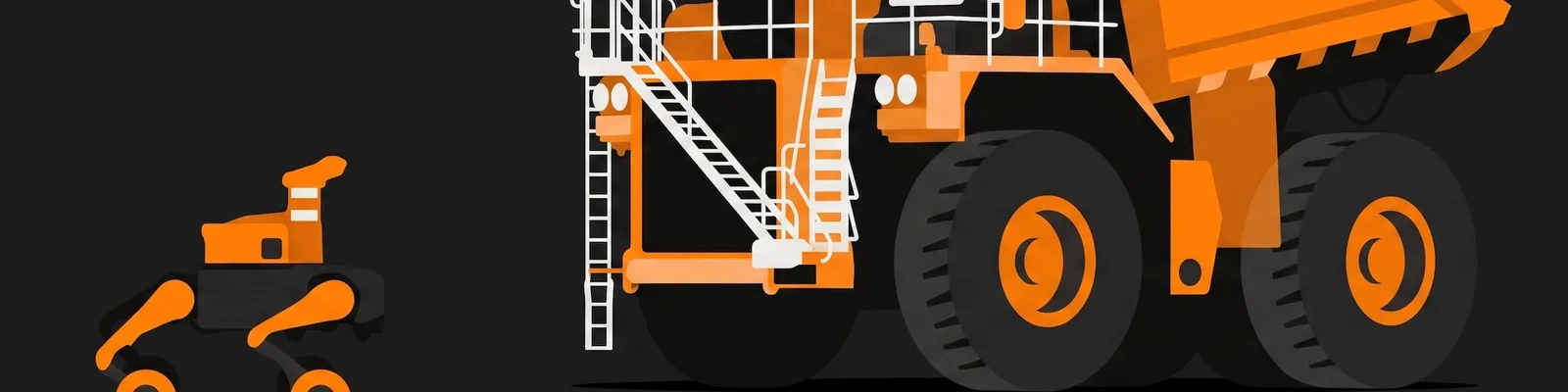
🚜 Caterpillar plans to transform construction sites
In summary: Caterpillar just partnered with FieldAI to push physical AI and robot-agnostic autonomy beyond mining and into jobsites and factories, deploying foundation models for inspections, digital twins and situational awareness.
The details:
Caterpillar is one of the world’s largest manufacturers of construction and mining equipment. FieldAI is a physical AI and robotics company, backed by Bezos Expeditions and NVIDIA's NVenture
Caterpillar is sitting on a rare trove for training AI models: roughly 1.6 million connected machines and 16+ petabytes of operational data
First applications plan to cover autonomous inspections, jobsite and facility digital twins, situational awareness, and simulation-driven optimisation. Construction sites are messy, these are incredibly sensible places to start (imo)
The partnership plans to extends Cat's mining playbook of automated haul trucks and drills, plus its NVIDIA Omniverse work on digital twins, into construction sites
Why it matters: Caterpillar already has autonomous haul trucks in mining's controlled pits, keeping people away from dangerous work. Quarries might be a stepping stone before physically taking part in construction activities. But my bet is that there is an opportunity to this technology on construction sites sooner than expected. Earthworks - excavation, loading, hauling and grading - is the likeliest starting point, repetitive enough to suit autonomy.
AEC's likely new hire: fleet manager / autonomy supervisor, with one person overseeing several semi-autonomous machines rather than driving one

Source: AEC field notes
🧮 Mathematical proofs are now machine-checkable
In summary: Anthropic just released the first complete computer-checked proof of Fermat's Last Theorem, with Claude spending 11 days largely autonomously turning Wiles's 1995 proof into 13 million lines of verifiable code, start to finish.
The details:
The theorem was already proved by Wiles in 1995; the news here is turning that proof into machine-checkable verification, not a new result
Working largely autonomously using Prove2Me (an open collaborative platform for formalising mathematics), Claude wrote 13 million lines in the programming language Lean, and proved 29,500 intermediate theorems
Kevin Buzzard, the driving force behind a massive community effort at Imperial College London to formalize Fermat’s Last Theorem (FLT), reviewed the proof and called it an ‘extraordinary auto-formalization achievement’
Proving math theorems requires assembling complex logical chains, and automatically formalizing a proof as complex as FLT is a significant step towards a future in which mathematics can be readily checked
Why it matters: Building compliance, and engineering calculations, are examples of much (much) simpler bodies of established rules & reasoning. Once any company can formalize those rules and they become machine-checkable against a BIM model, fundamental shifts could happen: 1) Architects and Engineers will be able to verify their own work quicker, but so will AI Agents which can 3D model semi-autonomously, 2) Clients, and contractors, can reduce risk by verifying work before accepting it, 3) Building control time to acceptance reduces
AEC's likely new hire: Client and contractor-side Design Managers with Architecture & Engineering acumen, able to run and interpret machine-verified deliverables to de-risk acceptance.

Source: AEC field notes
🛰️ Google's AI spots methane leaks at scale
In summary: Google Research just published MAPL-EMIT, a deep-learning system that reads NASA satellite data to detect methane leaks and pinpoint their source automatically, catching 84% of expert-verified plumes and 50% more than older detection methods.
The details:
MAPL-EMIT runs on NASA JPL's EMIT spectrometer aboard the ISS, an instrument originally built to map minerals, not detect gas
With no large real-world labelled dataset of methane plumes available, Google trained the model on 3.6 million simulated ones instead
Google is releasing the plume database, trained model, and inference code openly
This break though is part of Google’s broader effort behind Google Earth AI, which aims to process worldwide information into actionable intelligence
Why it matters: Buildings account for 39% of global energy-related carbon emissions, according to the World Green Building Council, 28% from operations alone. Some countries require owners of real estate to regularly report operational carbon emissions. AI instead enables independently verified continuous monitoring at scale globally, which will allow stakeholders in the construction industry to make informed decisions
The irony: Data centres powering these AI models will be guilty of a significant proportion of new emissions

Source: AEC field notes
⚖️ EU brands ChatGPT a search engine, not a chatbot
In summary: The European Commission just classified ChatGPT as a 'very large online search engine' under the Digital Services Act (DSA) - the first AI chatbot treated as search infrastructure, alongside Google and Bing, after it hit 159 million monthly EU users.
The details:
Reddit and Roblox got the same tag: Reddit reported 57.2 million average monthly EU users and Roblox roughly 48 million, both clearing the DSA's 45 million threshold
All three now have four months to run risk assessments covering illegal content, minors' safety, mental health and election integrity
Non-compliance can cost up to 6% of a company's global annual turnover, the same penalty regime that already applies to Google and Meta
Why it matters: Responses from ChatGPT, and other AI models, have become influential sources of generated & synthesized information. But they aren’t accurate, they don’t accept any liability, and shouldn’t be blindly referenced. Stricter regulation could create a market for “trusted AI” in AEC. Specialised models may compete on reliability, auditability, source traceability, testing, governance and guarantees around how they behave in our industry

Source: AEC field notes
🤖 Automate repetitive tasks with custom ‘Skills’
In summary: Custom skills are easy to create and work best on specific, repeatable tasks like meeting minutes from diarised transcripts, or regular reporting. If you're new to them, start with text-based tasks that already follow a template. 1 repeatable task = 1 ‘Skill’
Set expectations: Skills aren't perfect and don't replace the author's responsibility. They cut the time to execute, by as much as 50% in my experience, which is reason enough to take notice. What they can't do is the thinking beforehand, or the checking and reviewing using your project knowledge.
The details: the principles and the pitfalls are the same whichever AI provider you use:
Feed it enough samples: For example, provide Claude several pairs of a meeting minutes document you wrote and the diarised (with speaker names) Microsoft Teams transcript behind it, plus the blank template you want the skill to use in future.
Don't write skills yourself, at least at first: Every major vendor has a built-in skill for creating skills - let AI write and update its own instructions, and learn how it does so
Don't give up on a skill with potential: Either tell the model what's wrong, or finish the output yourself and hand it back explaining what you changed, and ask it to fine-tune the skill
Use a skill: Can be manually triggered (e.g. using
/in Claude, or@in ChatGPT), or may be automatically triggered if relevant to a conversationSkills are sharable: A skill you create can be re-used by your team or friends, providing they use the same vendor
Get started in two prompts:
Prompt 1:
"Attached are three ZIP folders. Each contains a diarised Teams transcript and the meeting minutes I wrote from it. Also attached is the empty Microsoft Word template I use. Create a reusable skill called 'minutes-from-transcript' that takes a diarised Teams transcript and produces meeting minutes in our template.”
Prompt 2:
"Attached are two files: the raw output of the 'minutes-from-transcript' skill, and my edited version. Refine the skill so I have fewer edits to make next time.”
Top tip: skills can be called from Projects and use Project resources. Diarised transcripts label speakers by name, but actions in meeting minutes are usually attributed to companies, often by acronym. Put a small table of names, companies and acronyms in the project, and the skill can swap the names for acronyms as it writes - if you ask it to.
The above should be enough to get started. But if you fancy becoming an expert, or you run into trouble, below is the official documentation from the most commonly used AI model providers:
OpenAI (ChatGPT) has the best guidance for beginners
Anthropic (Claude) is my go to, but the complete guidance can be abstract if you are starting out. Even its basic guidance can feel too detailed
Google (Gemini) is starting to implement skills, so this guidance may soon change
Microsoft (Copilot) may soon add it to consumer / enterprise Copilot, but today it only exists in its developer-facing product (Copilot Studio)
Haven’t started using any of these? Check out our guide on how to start using frontier AI models for free
Trending AI Tools this week
Two frontier leaps, with plenty of demos already circulating on how they slot into 3D modelling workflows:
Simpler, yet much more affordable releases(8-13x cheaper):
That’s it for today!
See you next week with more exciting updates,
Eduardo - The human behind AEC field notes